Conversions
Conversions remove ambiguity. Ambiguity ruins consistency.
Math
Why conversions matter
“A cup” is not a standard in real kitchens. Brands, scoops, and packing vary.
Conversions are not trivia—they are the difference between repeatable outcomes and guesswork.
Professional measurement discipline
Use a scale for flour, sugar, and anything structural
Measure liquids by volume when appropriate, but weigh when precision matters
Record what you did so results can be repeated
Core kitchen conversions
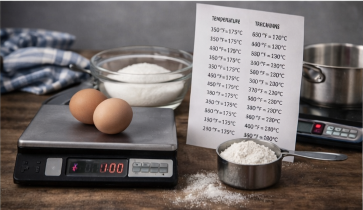
US ↔ metric volume and weight tablesTemperature (°F ↔ °C) and practical oven rangesMass (oz ↔ g, lb ↔ kg)Scaling multipliers and yield control basics
Start with the overview, then use the linked tables for exact values and practical working ranges.
Common errors
Assuming “cups” of flour are consistent across kitchens
Reducing salty liquids without accounting for concentration
Scaling a recipe without scaling pan size, cook time, and heat transfer
Pair this with Ratios to build a complete, durable measurement system.
What this helps you control
Goal
Turning cooking production into a repeatable system: inputs → process → controls → outcomes.
Predictability: your process produces the same result when inputs match.
Timing: when each step happens and what can hold without damage.
Heat + moisture: the two dials that change texture fastest.
Salt, acid, fat: the balance levers that define “finished.”
Process standards
Use these as “defaults.” Deviate intentionally and only when you can name the tradeoff.
Set a finish target before you start (texture + doneness + serving temp).
Choose one primary control dial (heat, time, thickness, agitation) and protect it.
Stage tools and ingredients so the next 3 actions require no searching.
Use a single checkpoint mid-way (look / sound / feel) to decide adjustments.
Helpful hint
If you feel lost mid-cook, return to a single dial: heat , time , thickness , or agitation . Stabilize one, then adjust the rest.
Failure modes & recovery
Most “bad outcomes” are predictable. Use the signal, then apply the smallest correction.
Failure mode Signal Recovery
Rushed sequencing Food finishes before the room is ready Hold the component that tolerates holding; delay the fragile component. Heat drift Pan/pot gets too hot or too cool Reset: pull off heat 30–60s, then re-enter at target power. Under-seasoned finish Tastes flat at the table Add salt in small increments + a micro-acid correction.
Practice lab
How to use this set
Answer quickly, then read the explanation. Repeat until you can predict the correct choice before you click.
1. What does a “finish target” describe?
A. The garnish onlyB. Texture + doneness + serving temperatureC. The grocery listD. The cooking vessel
Show hint
2. Which dial changes texture fastest in most cooking?
A. Music volumeB. Heat + moistureC. Plate colorD. Recipe title
Show hint
3. How should you decide when to check cooking progress?
A. At recipe checkpoints, adjusting as the food changesB. Only at the endC. Every 2 secondsD. Never
Show hint
4. Best first recovery when the pan is running too hot?
A. Add more sugarB. Pull off heat briefly to resetC. Walk awayD. Add ice directly
Show hint
5. A quick way to fix ‘flat’ flavor at the end:
A. More pansB. Salt in small increments + micro-acidC. Add waterD. Remove herbs
Show hint
6. The point of mise en place is mainly:
A. DecorationB. Reduce searching + protect timingC. Add more dishesD. Make it harder
Show hint
Keep something useful for your next meal Choose a dish, find your next read, or connect with food grown closer to home.
Advertisement
Enable Marketing cookies to show banners.
Cookie preferences Cookie preferences could not open. Check whether your browser is blocking the consent manager, then reload the page.
Enable JavaScript to load merchant banners after choosing Marketing cookies. The merchant link below remains available.
Loading merchant banner…
Practical Home and Kitchen Shopping at Blain's Farm & Fleet Compare the buying guide with your needs, available space, and budget before visiting Blain's Farm & Fleet.
Loading merchant banner…
Choosing a KitchenAid Mixer by the Work You Actually Do Compare the buying guide with your needs, available space, and budget before visiting KitchenAid.
Previous banner 1 of 2 Next banner Pause rotation

 Math
