
Loading merchant banner…
Choosing a KitchenAid Mixer by the Work You Actually Do
Compare the buying guide with your needs, available space, and budget before visiting KitchenAid.
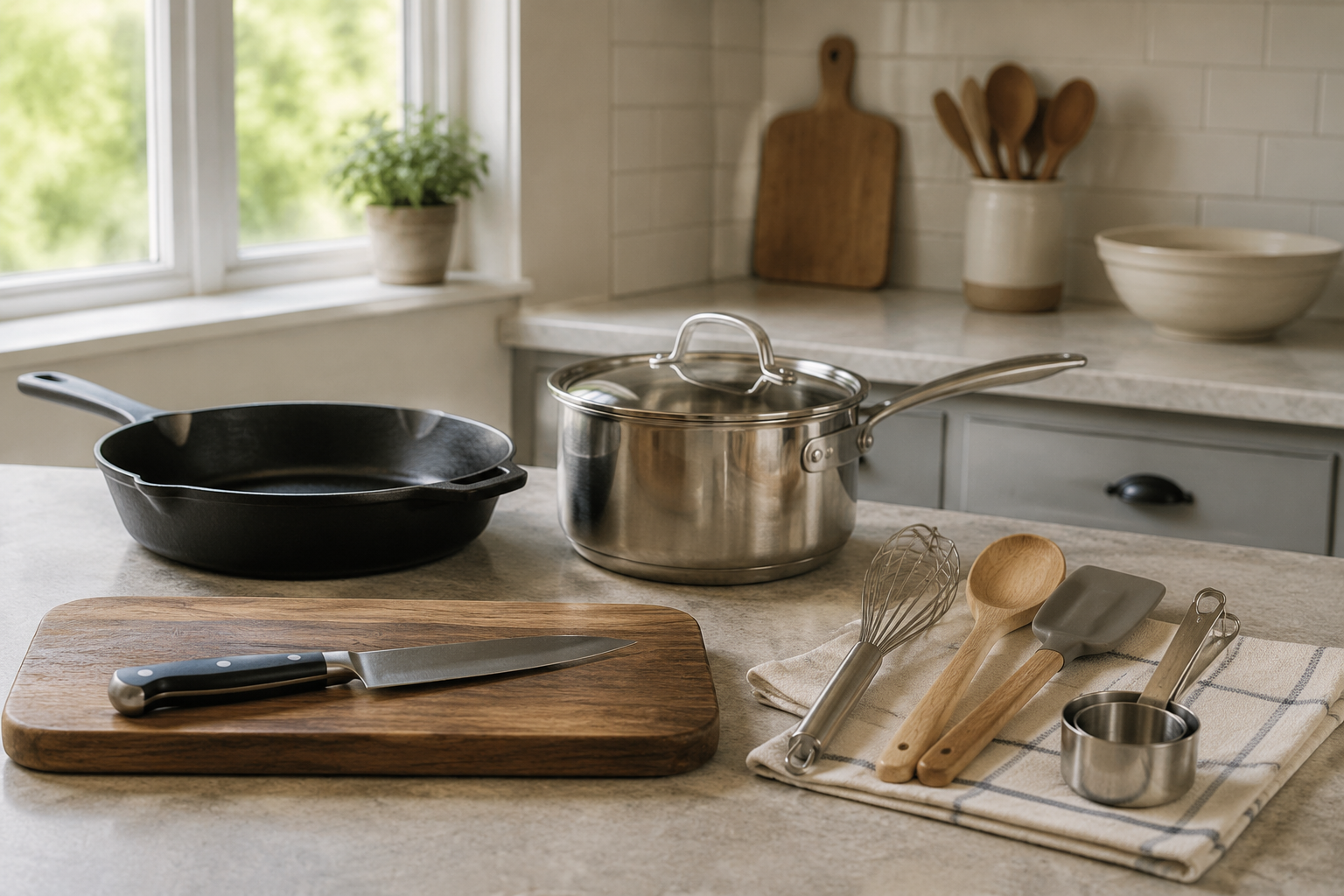
Equipment is not decoration. Each tool controls a variable: heat transfer, measurement, agitation, surface contact, or time. These pages define what the tool controls, how to verify it is doing its job, and what failures look like when it is not.
Each equipment page follows the same structure: definition, what it controls, minimum viable set, materials/surfaces, failure modes, maintenance, and crosslinks.
A “better pan” won’t fix process problems, but the right minimum kit removes friction and makes standards easier to follow. Use these kits as a baseline; add specialized tools only when they unlock a new method.
Chef’s knife + board, scale, instant-read thermometer, sauté pan, saucepan, sheet pan, tongs, spoon, fine salt.
Heavy pan (cast/tri-ply), high-smoke fat, thermometer, splatter control, cooling rack for airflow.
Scale, oven thermometer, mixing tools, parchment, measuring spoons, loaf/sheet pans, cooling rack.
Dutch oven/stockpot, fine strainer, ladle, freezer containers, labels for FIFO.
If you’re diagnosing inconsistent results, start with Thermometry and Scales & measuring.
Buying “better tools” is rarely the fastest upgrade. What matters is whether the tool reliably controls a variable. In practice, most equipment affects one of four control families:
If you can’t tell what variable a tool controls, it’s probably not a priority purchase.
“I cooked it the same way” only works when your tools are telling the truth. Calibration does not need to be obsessive — it just needs to be periodic and documented enough that you trust your measurements.
Use a known reference test appropriate to your thermometer type. Many cooks use an ice-water slurry for a low-point check and boiling water for a high-point check, but exact reference temperatures vary with conditions (altitude, water purity, and method). Your goal is not perfection; it is knowing whether the tool is “in family” and consistent. If it is not, replace or re-calibrate per the manufacturer.
Tip: verify where you measure. On thin foods, probe placement matters as much as accuracy.
A kitchen scale is the fastest route to repeatability in baking and seasoning. Check that the scale returns to zero, does not drift when a bowl is on it, and is stable on your countertop. If you need confidence, compare readings using a known reference weight (or multiple items whose weights are printed and consistent) and confirm the scale repeats.
Many ovens run hotter or cooler than the dial and can have hot spots. A simple oven thermometer and a short “mapping” pass (checking multiple positions over time) reveals the pattern. Once you know your oven, you can place trays intentionally and rotate at predictable checkpoints instead of guessing.
The difference between “messy home cooking” and “professional flow” is usually station design, not talent. Set up your tools so that phase changes (raw → cooked → finished) include natural reset points.
Keep a clean board and a clean knife available for ready-to-eat work. When you move from raw proteins to finishing, you swap tools — you don’t “try to be careful.”
Stage a resting rack/plate, a clean spoon/tongs, and a warm holding spot before you cook. This prevents the common scramble where food overcooks while you search for tools.
Keep a small “reset kit” (towels, sanitizer/wipes, trash bowl). Quick resets protect safety and keep technique consistent because your surfaces stay functional.
Pair equipment setup with Mise en place for sequencing rules.
If you want to spend money wisely, upgrade in the order that removes the most uncertainty: measure → heat control → mechanics → specialty.
“Pan performance” is mostly material science: heat capacity, conductivity, and surface behavior. Pick the material that matches the job, then learn its standards.
High heat capacity and strong contact. Great for browning and searing. Requires drying and care; performance improves with use.
Balanced responsiveness and durability. Great “default pan” for pan sauces, sautéing, and mixed tasks where you want control.
Low-stick surface for eggs and fragile foods. Not a high-heat searing tool. Protect coatings; avoid metal tools and overheating.
Stable environment for braises, stews, and bread. Lid fit and mass matter; it’s a moisture and temperature control tool.
Some sticking is a sign the crust hasn’t formed yet. With stainless and cast iron, food often releases when browning is complete. Sticking becomes a problem when the surface is too cool, the load is wet, or you try to move food too soon. Use preheat discipline, dry surfaces, and correct fat choice to improve release.
Knife “skill” is mostly edge + board + grip. A sharp knife with a stable board makes safe cuts easier and reduces fatigue. A dull knife forces pressure and increases slips.
Crosslink: Knife cuts for standards and practice reps.
How you store tools affects how you cook. Accessible tools get used; buried tools create friction and shortcuts. Aim for “one motion” access for your daily kit.
The easiest way to stay safe is a continuous loop: scrape → rinse → wash → dry. It prevents clutter, reduces cross-contamination, and makes your station more predictable, which improves technique.
Use this to avoid impulse tools. If a tool doesn’t pass the checklist, it probably won’t change outcomes.
Different thermometers solve different problems. Choose based on the measurement you need.
Crosslink: Thermometry.
If you’re chasing consistency, keep a tiny log: oven behavior, burner quirks, and the settings that produce good results. This turns “my stove runs hot” into actionable knowledge you can repeat.
Turn Index into a repeatable system: inputs → process → controls → outcomes.
Use these as “defaults.” Deviate intentionally and only when you can name the tradeoff.
If you feel lost mid-cook, return to a single dial: heat, time, thickness, or agitation. Stabilize one, then adjust the rest.
Most “bad outcomes” are predictable. Use the signal, then apply the smallest correction.
Answer quickly, then read the explanation. Repeat until you can predict the correct choice before you click.
Quick self-check
1. Honing vs sharpening—honing mainly:
3. Best safety rule for knife work:
4. A scale improves baking because it:
5. Best time to calibrate a thermometer:
6. Choosing a tool should prioritize:
Advertisement
Loading merchant banner…
Compare the buying guide with your needs, available space, and budget before visiting KitchenAid.
Loading merchant banner…
Compare the buying guide with your needs, available space, and budget before visiting Blain's Farm & Fleet.
